What a DEXA scan shows about your body, and what it costs
Quick answer: A DEXA scan is a quick, very low-dose X-ray that shows what your body is made of: how much fat, muscle and bone you have, and where it sits. People get one for two main reasons. Doctors use it to check bone strength and catch thinning bones before they break. And people who care about their health use it to see their fat and muscle, which a bathroom scale can’t tell apart. It takes about 10 to 30 minutes, you stay dressed, and it costs $65 to $249 at clinics that publish a price.
One machine, two different pictures
There are actually two kinds of DEXA scan, and it helps to know which one you’re getting.
Think of the DEXA machine as a camera. The bone density scan is a close-up of your hip and spine. The body composition scan is a full-length photo of you from head to toe.
Same camera, very different pictures. A close-up of your hip tells you nothing about your belly fat, and the full-length shot isn’t sharp enough to judge your bones the way a doctor needs. Many clinics that advertise “a DEXA scan” mean the body composition one, so if bones are what you care about, ask for the hip and spine scan by name.
How the scan works
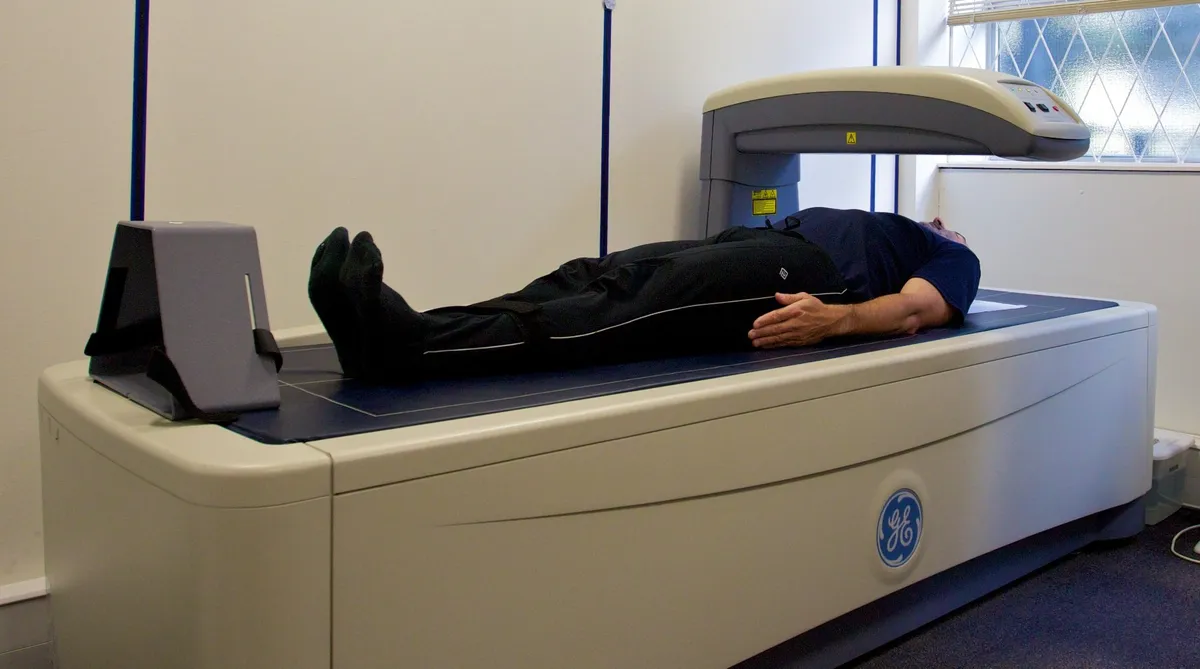
DEXA (also written DXA) stands for dual-energy X-ray absorptiometry. A source under the table sends a very weak X-ray beam up through your body at two different energies, and a detector above you measures how much gets through.
Why two energies? Picture shining two colors of light through stained glass. Each type of glass dims each color by a different amount, so comparing the two shadows tells you what the glass is made of. DEXA does the same thing with bone, fat and lean tissue.
A small beam. A clearer picture.
DEXA (also called DXA) uses very low-dose X-rays at two energy levels. A detector measures how much passes through the body.
- Lie on an open table
The detector sits above you; the X-ray source is below the table.
- Stay still for the scan
The detector passes over the area being measured.
- Measurements become a report
Software calculates results for the selected scan protocol.
You lie on an open table in your clothes, minus anything metal, and stay still for about 10 to 30 minutes. Nothing goes over your face and it’s quiet. The dose is tiny, less than a tenth of a standard chest X-ray, though you should tell the staff first if you are or might be pregnant.
Which scan are you booking?
| Question | Bone density scan | Body composition scan |
|---|---|---|
| What it looks at | Your lower spine and hips | Your whole body, region by region |
| What you get | A T-score for your bones | Fat, lean tissue and bone, and where each sits |
| Who usually orders it | Your regular doctor, often covered by insurance if you qualify | You or a longevity clinic, usually self-pay |
| When people retest | Every couple of years, or as a doctor suggests | A few months after a real change in training or diet |
What a DEXA scan costs
At the clinics we track that publish a price, a DEXA scan costs $65 to $249, and a typical price is about $140. You usually pay for it yourself, with no membership needed, which makes it one of the easiest ways to try longevity testing.
If your doctor orders a bone density scan because you meet the screening criteria, insurance often covers it, and Medicare covers one every 24 months for people who qualify. Body composition scans are usually self-pay. Many clinics also let you book DEXA and a VO2 max test in the same visit. For more on what clinics charge, see how much longevity clinics cost.
Prices change over time, so check with the clinic before you book.
Enter your ZIP code to see clinics near you that offer DEXA scans.
Reading a body composition report
This is the report most longevity clinics hand you, and it’s where DEXA beats a bathroom scale. Two people can weigh exactly the same and carry very different amounts of fat and muscle. The scan shows you which is which, and later, whether it’s changing.
There’s more to weight than a number.
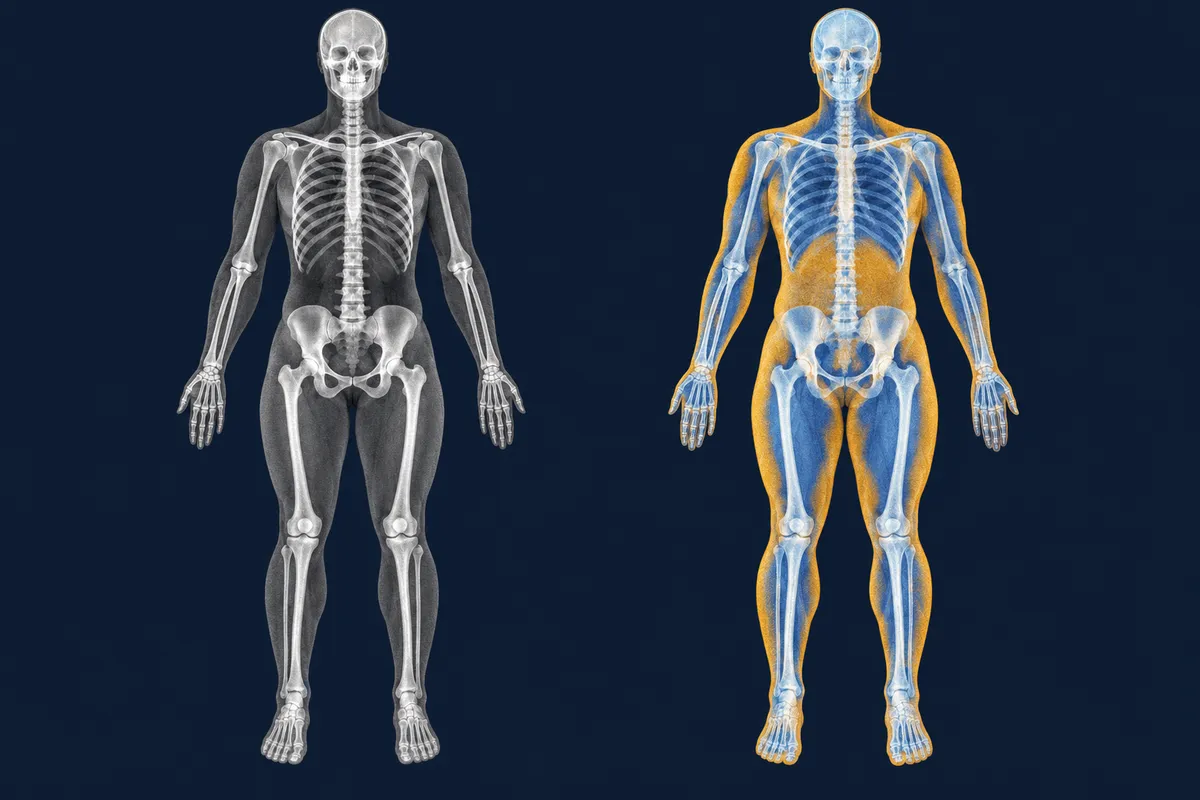
A whole-body DXA report separates estimated mass into fat, lean soft tissue and bone mineral content.
Lean soft tissue includes muscle, organs and water. It is not a muscle-only measurement.
AI-generated educational illustration · not a patient scan
Colors explain tissue categories; they are not a measured tissue map.
Estimated fat across the body.
Includes muscle, organs and water.
The mineral component of bone.
30% fat · 66% lean soft tissue · 4% bone mineral
Example values, not targets or reference ranges.
Lean soft tissue is not a direct measurement of muscle alone. A body composition scan also does not replace a dedicated hip-and-spine bone-density exam.
The headline numbers are your body fat percentage and your lean mass. Lean mass is everything that isn’t fat or bone, which is mostly muscle but also includes your organs and water. That’s worth remembering when it jumps around between scans.
Most reports also break things down by region. Arm and leg lean mass is the line doctors often look at as a muscle measure, for example when checking for muscle loss with age. Many reports also estimate visceral fat, the fat packed around your organs deep in your belly. In one large study, the DEXA estimate lined up closely with MRI. If you’d like a simple way to keep an eye on it at home between scans, see visceral fat and waist measurement.
You’ll see a whole-body bone number too, but it isn’t the one used to diagnose osteoporosis. For that you need the hip and spine scan.
There’s no single “good” body fat number on a DEXA report, because reference ranges vary by machine maker. The comparison that means the most is you against your own last scan.
Reading a bone density report
First, the two words you’ll see on a bone report.
Osteoporosis means your bones have become thin and fragile on the inside, so they break much more easily. A small fall that would just bruise most people can break a hip or wrist. It usually causes no pain or symptoms until a bone breaks, which is why a scan is the way to find it early.
Osteopenia, or low bone density, is the step before. Your bones are thinner than normal, but not yet thin enough to be called osteoporosis. It’s a heads-up, not a diagnosis of disease.
Your result comes as a T-score. Think of it as how your bones compare with a healthy young adult’s: zero means the same, and the more negative the number, the thinner your bones. Drag the marker below to see how the ranges work.
What does a T-score mean?
A T-score compares bone mineral density with a young-adult reference. It is not a percent of bone lost. Zero means the same as a healthy young adult; the more negative, the thinner the bones.
(also called osteopenia)
These ranges are for women after menopause and men 50 and older. Younger people usually get a Z-score instead. A clinician interprets the result alongside fracture history and other risk factors.
Women before menopause and men under 50 usually get a Z-score instead, which compares you with people your own age and sex.
A normal score is good news, but it isn’t the whole picture. In one study of older women, about 3 in 4 fractures happened in women whose scan did not show osteoporosis, partly because there are so many more people in that group. That’s why doctors read bone density alongside your age, past fractures, medicines, balance and strength.
Why your numbers can move when you didn’t
Some of the change between two scans is real. Some is just the scan.
Water is the big one. In one study, drinking about a liter of water raised measured lean mass by nearly 2 pounds within an hour. No new muscle, just water. A large meal or a hard workout right before can shift things too.
The machine matters as well. Two brands of DEXA machine can read the same spine quite differently, in one study by up to 20%, which is bigger than most of the change you’re hoping to see. So a scan at a new clinic isn’t a fair “after” picture for one you had somewhere else.
The fix is simple: go back to the same place and the same machine, at the same time of day, with the same routine beforehand. Skip calcium supplements for 24 hours before a bone scan. And keep your full reports, not just the app summary, so you or your doctor can compare later. There’s more on this in baseline testing vs retesting.
What DEXA can’t tell you
A DEXA scan can show that your bone density is low, but not why. Working that out takes a conversation and blood tests with your doctor.
It also can’t tell you how strong or fit you are. Lean mass is how much muscle you have, not what it can do, which is why many clinics pair DEXA with a VO2 max test or a grip strength test. And it isn’t a scan of your organs. Looking for things like tumors is a different kind of test, covered in full-body MRI vs blood biomarkers.
Who tends to get each scan
The bone density scan is part of regular care for a lot of people. National guidelines recommend it for women 65 and older, and for younger women past menopause who have extra risk. Your doctor may also suggest it if you take long-term steroids or have broken a bone in a minor fall. Medicare covers one every 24 months for people who qualify.
The body composition scan is popular with people who want to see what’s under their weight. Maybe you’re starting a strength or nutrition plan and want a “before” picture, or your weight has held steady but you suspect you’re losing muscle. It’s most useful when you plan to scan again, so you can see the change.
Questions to ask before you book
- Is this the hip and spine bone scan, the whole-body scan, or both?
- Will my next scan be on the same machine?
- How should I prepare, and will it be the same next time?
- Who goes over the results with me?
Common questions
Is a DEXA body composition scan the same as a bone density scan?
No. It’s the same machine running a different scan. The bone density scan looks at your hip and spine. The body composition scan looks at your whole body and reports fat and lean tissue. If bones are your question, ask for the hip and spine scan by name.
How much radiation is in a DEXA scan?
Very little: less than a tenth of a standard chest X-ray. Tell the staff first if you are or might be pregnant.
What is a good body fat percentage on a DEXA scan?
There’s no single number. Ranges differ by machine maker and by the group they were built from. The most useful comparison is your own previous scan on the same machine.
Can I compare DEXA results from two different clinics?
Not reliably. Different machines can read the same person quite differently. For a true before-and-after, scan at the same place on the same machine.
How often should I get a DEXA scan?
For bones, often every couple of years, or whatever your doctor suggests. For body composition, a few months after a real change in training or diet is usually enough to see something.
Does insurance cover a DEXA scan?
A bone density scan is often covered when your doctor orders it and you meet the criteria. Medicare covers one every 24 months for people who qualify. Body composition scans are usually self-pay.
Prepared by the LongevityClinicsHub editorial team. How we research and source these guides.
Enter your ZIP code and we’ll point you at the nearest city we’ve researched.
Keep reading

Sources
- ACR and RSNA, RadiologyInfo: Bone Density Scan (DEXA)
- NIAMS (NIH): Bone Mineral Density Tests, What the Numbers Mean
- International Society for Clinical Densitometry: Adult Official Positions
- U.S. Preventive Services Task Force: Osteoporosis to Prevent Fractures, Screening
- Medicare.gov: Bone mass measurements
- Pasco JA et al., The population burden of fractures originates in women with osteopenia, not osteoporosis. Osteoporosis International
- Neeland IJ et al., Visceral fat by DXA and MRI: the Dallas Heart Study. Nutrition & Diabetes
- Cross-calibration of GE Lunar Prodigy and Hologic Horizon W, Journal of Bone Metabolism
- Influence of passive, diet-based hydration on muscle quantity assessment, Frontiers in Physiology
- Cruz-Jentoft AJ et al., Sarcopenia: revised European consensus (EWGSOP2). Age and Ageing
This guide is independent editorial content, written to orient, not to diagnose. It is not medical advice, and it is no substitute for a conversation with a licensed physician who knows your history. Where we describe what clinics claim, the claim belongs to the clinic.
Educational reading, not medical advice. Talk to a clinician about your own health.