What is VO2 max, and what’s a good number for your age?
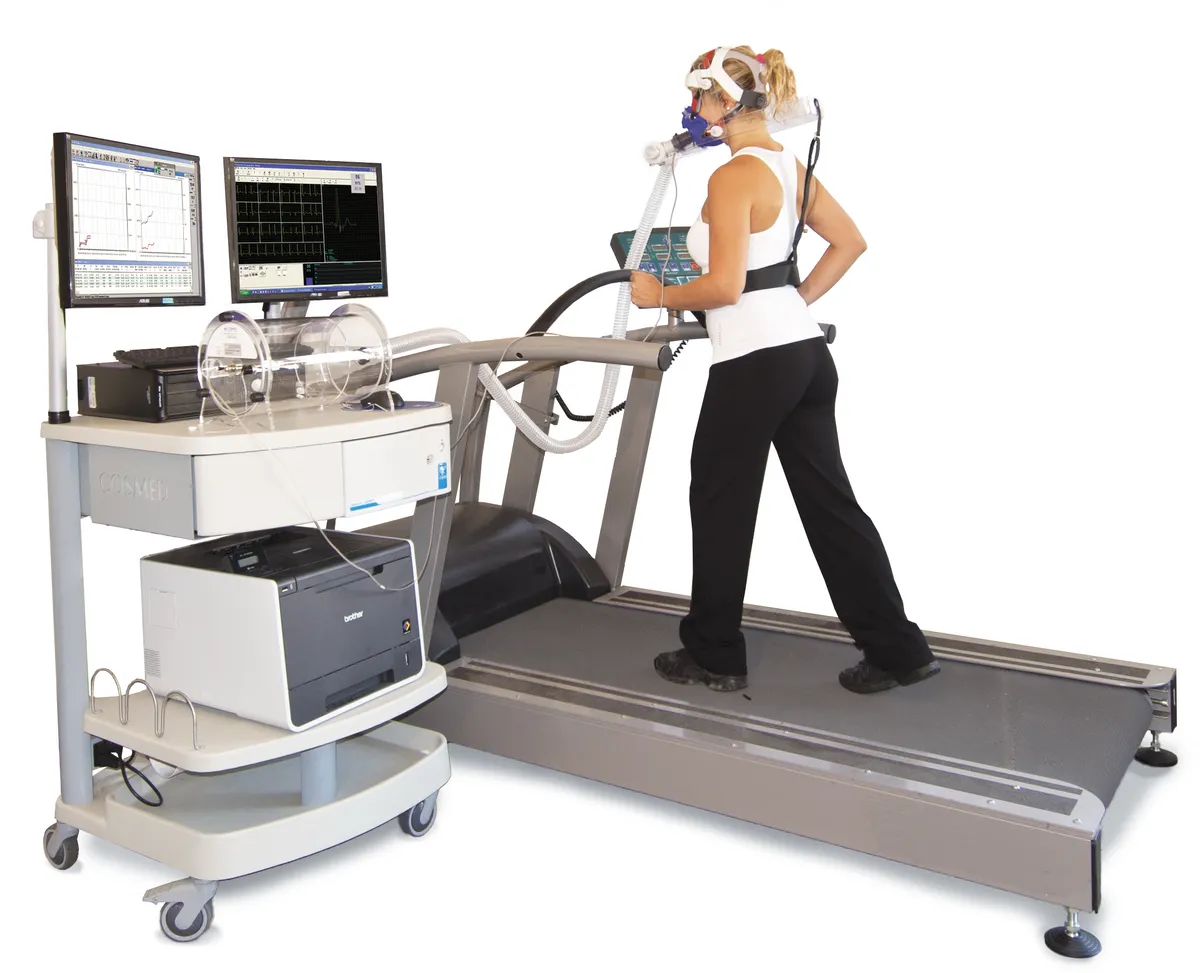
Photo: COSMED, CC BY-SA 3.0
Quick answer: VO2 max is how much oxygen your body can use when you’re working as hard as you possibly can. It’s one of the best single measures of your overall fitness, and people with higher numbers tend to live longer. A lab test measures it directly while you run or cycle with a mask on, takes about 8 to 12 minutes of exercise, and costs $100 to $675 at clinics that publish a price. The good news: it’s a number you can raise.
What VO2 max actually means
Think of VO2 max as the size of your engine. Oxygen is the fuel. Your lungs bring it in, your heart pumps it around in your blood, and your muscles burn it to move you. VO2 max is how much fuel that whole engine can burn at full throttle.
One number, four parts working together
VO2 max is how much oxygen this whole chain can deliver and use at full effort. A weak link anywhere lowers the number.
A bigger engine doesn’t just matter for athletes. It’s what lets you climb stairs, carry groceries or keep up on a hike without running out of breath. Every daily task uses a slice of your maximum, so the bigger your maximum, the easier everything else feels.
The number is written in milliliters of oxygen per kilogram of body weight per minute (mL/kg/min). You don’t need to remember that. Higher is better, and the useful comparison is with people your age and with your own past results.
Why longevity clinics care about it
Because few numbers line up with a long life as closely as this one.
In a study of more than 122,000 adults who took a treadmill test, the least fit people were about five times as likely to die during the study as the fittest. Being unfit carried more risk than smoking, diabetes or heart disease did in the same study. And there was no ceiling: the fitter people were, the better they did. The American Heart Association has suggested that doctors treat fitness like a vital sign, next to blood pressure and heart rate.
One honest caveat: these studies show a strong link, not proof that raising your number by a set amount adds a set number of years. Fit people also tend to do many other healthy things. Still, it’s one of the strongest signals we have, and unlike your age or your genes, you can change it.
What’s a good VO2 max for your age?
VO2 max naturally falls as we get older. In a large US registry of lab tests, the typical man in his 70s had about half the VO2 max of the typical man in his 20s, and the same was true for women. Training can’t stop that slide, but it can start you from a higher point and slow it down.
The typical number halves from your 20s to your 70s
Lines show the typical (middle) result. The shaded band is the middle half of people. Hover a dot for the numbers.
Show as a table
| Age | Men (typical) | Women (typical) |
|---|---|---|
| 20s | 48.0 | 37.6 |
| 30s | 42.4 | 30.2 |
| 40s | 37.8 | 26.7 |
| 50s | 32.6 | 23.4 |
| 60s | 28.2 | 20.0 |
| 70s | 24.4 | 18.3 |
Have a number from a lab test? Pick your age and sex below to see where it sits.
What’s a good VO2 max for you?
Enter your age and sex to see the ranges for people like you. Add your number if you have one.
For men 40 to 49
- Top 10% 52.1 or higher You
- Well above most 45.0 to 52.1 You
- Above the middle 37.8 to 45.0 You
- Below the middle 31.9 to 37.8 You
- Lower than most Under 31.9 You
The typical result for men your age is 37.8.
VO2 max by age and sex
In mL/kg/min. Find your age row, then see where your number falls.
| Age | Lower than most | Below the middle | Above the middle | Well above most | Top 10% |
|---|---|---|---|---|---|
| 20s | Under 40.1 | 40.1 to 48.0 | 48.0 to 55.2 | 55.2 to 61.8 | 61.8 or higher |
| 30s | Under 35.9 | 35.9 to 42.4 | 42.4 to 49.2 | 49.2 to 56.5 | 56.5 or higher |
| 40s | Under 31.9 | 31.9 to 37.8 | 37.8 to 45.0 | 45.0 to 52.1 | 52.1 or higher |
| 50s | Under 27.1 | 27.1 to 32.6 | 32.6 to 39.7 | 39.7 to 45.6 | 45.6 or higher |
| 60s | Under 23.7 | 23.7 to 28.2 | 28.2 to 34.5 | 34.5 to 40.3 | 40.3 or higher |
| 70s | Under 20.4 | 20.4 to 24.4 | 24.4 to 30.4 | 30.4 to 36.6 | 36.6 or higher |
| Age | Lower than most | Below the middle | Above the middle | Well above most | Top 10% |
|---|---|---|---|---|---|
| 20s | Under 30.5 | 30.5 to 37.6 | 37.6 to 44.7 | 44.7 to 51.3 | 51.3 or higher |
| 30s | Under 25.3 | 25.3 to 30.2 | 30.2 to 36.1 | 36.1 to 41.4 | 41.4 or higher |
| 40s | Under 22.1 | 22.1 to 26.7 | 26.7 to 32.4 | 32.4 to 38.4 | 38.4 or higher |
| 50s | Under 19.9 | 19.9 to 23.4 | 23.4 to 27.6 | 27.6 to 32.0 | 32.0 or higher |
| 60s | Under 17.2 | 17.2 to 20.0 | 20.0 to 23.8 | 23.8 to 27.0 | 27.0 or higher |
| 70s | Under 15.6 | 15.6 to 18.3 | 18.3 to 20.8 | 20.8 to 23.1 | 23.1 or higher |
Keep in mind that these ranges come from people who had a lab test done, not from everyone, and different labs use different reference tables. So treat your percentile as a rough guide. The comparison that matters most is you against your own last test.
What the test is like
You run on a treadmill or ride a stationary bike while wearing a mask that measures the air you breathe in and out. It starts easy and gets a little harder every minute or two. After about 8 to 12 minutes, you reach the point where you can’t keep going, and that’s your peak.
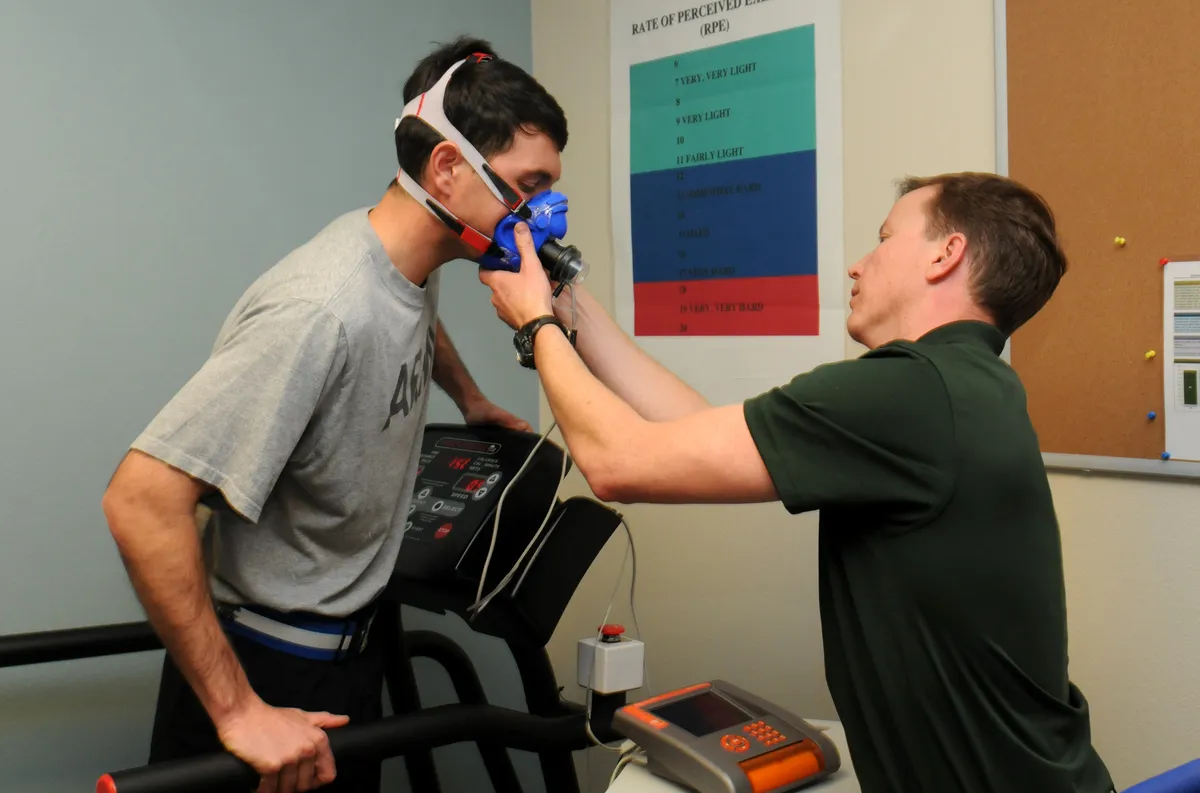
Expect to sweat, expect the last couple of minutes to be hard, and expect wobbly legs afterwards. Wear workout clothes and good shoes, skip a big meal and caffeine for a few hours before, and don’t do a hard workout the day before.
Because the test asks for a true all-out effort, a good clinic asks about your health first. If you have heart disease, chest pain or high blood pressure that isn’t under control, you may need a doctor present or a different kind of test. That screening is a sign of a careful clinic, not a hassle.
Lab test vs your smartwatch
Your watch may already show you a VO2 max. That’s an estimate, worked out from your pace and heart rate. It doesn’t measure oxygen at all.
| Question | Lab test | Watch estimate |
|---|---|---|
| How it works | Measures the oxygen you actually use, breath by breath | Estimates from your pace and heart rate |
| Effort | An all-out effort, once | Nothing extra, just your normal runs or walks |
| Accuracy | The gold standard | Can be off by quite a bit for any one person |
| Best for | A real baseline and serious retests | Watching your own trend over time |
How far off can a watch be? In one 2025 study, the Apple Watch read about 6 points lower than a lab test on average, roughly 13% off. That doesn’t make your watch useless. If its number climbs over a few months, you’re probably getting fitter. Just don’t treat a single watch reading as your real VO2 max.
What a VO2 max test costs
At the clinics we track that publish a price, a VO2 max test costs $100 to $675, and a typical price is about $170. You usually pay for it yourself, with no membership needed. The price depends on how much the clinic includes, from the test alone to a full results review and a training plan built on your numbers.
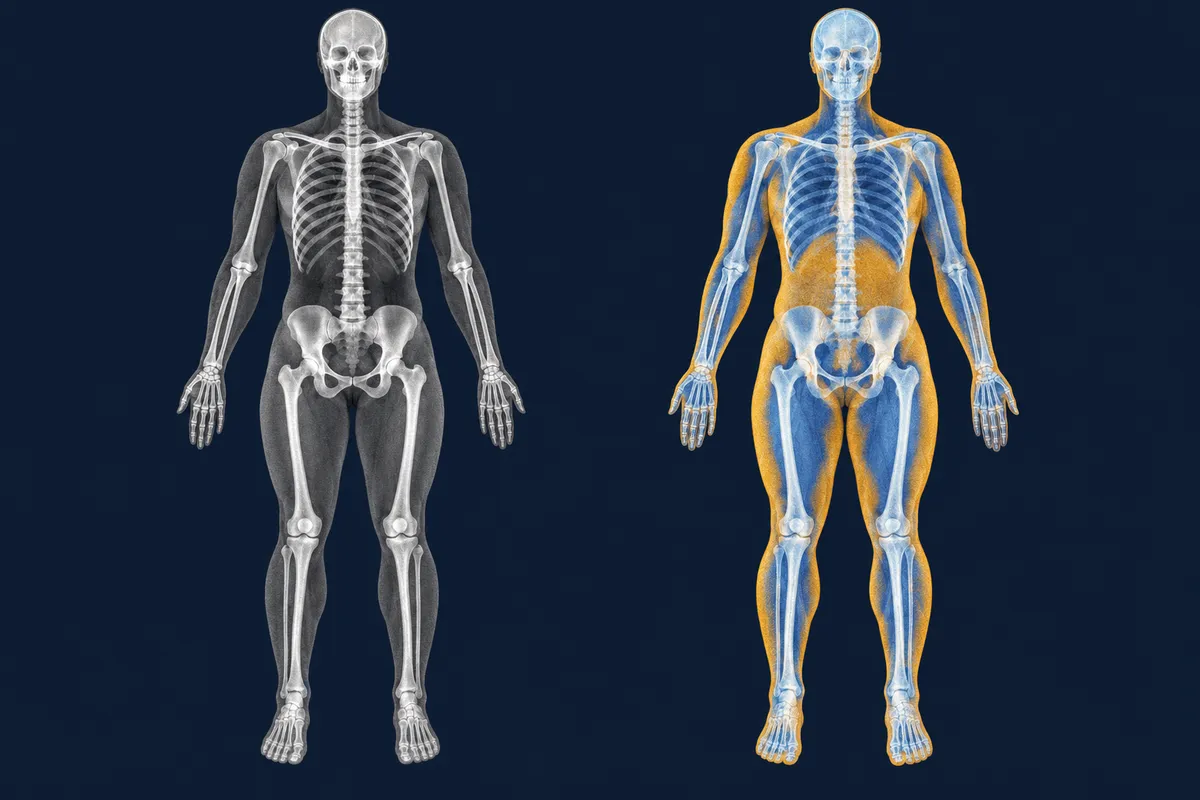
Many clinics let you book a VO2 max test and a DEXA scan in the same visit: one shows what your body can do, the other what it’s made of. For more on what clinics charge, see how much longevity clinics cost. Prices change over time, so check with the clinic before you book.
Enter your ZIP code to see clinics near you that offer VO2 max testing.
Can you raise your VO2 max?
Yes, for most people, and that’s the best part of measuring it.
What tends to work is a mix of two kinds of cardio. Most of it is steady, comfortable effort you could keep up while talking, like brisk walking, easy cycling or jogging. A smaller part is harder intervals, short bursts where talking gets tough, with rest in between. US guidelines suggest adults get 150 to 300 minutes of moderate activity a week, or 75 to 150 minutes of vigorous activity, plus strength training twice a week.
People who start from a lower fitness level often see the biggest gains. Either way, it takes months of steady effort to show up in a retest, not weeks. A retest about three to six months after you change your routine is a good way to see if it’s working.
What the number can’t tell you
A VO2 max test measures how much your body can do. It doesn’t look inside your heart’s arteries, so a great result doesn’t mean they’re clear. Very fit people can still have plaque, and the test doesn’t replace the heart screenings your doctor recommends.
It also can’t tell you on its own why a number is low. That could come from being out of shape, a heart or lung issue, or just a bad day. A clinician reading the full test can usually help sort that out. And small changes between tests, a point or two, can come from sleep, a different machine or even switching from a treadmill to a bike, so look for a trend rather than reading too much into one result.
Finally, VO2 max is one part of fitness. Strength, balance and muscle matter too, which is why many clinics pair it with grip strength or a DEXA scan.
Questions to ask before you book
- Is this a full lab test with a mask, or an estimate?
- Who checks my health beforehand, and who’s in the room during the test?
- Will my retest use the same machine and the same protocol?
- Who goes over the results with me, and will I get a plan?
Common questions
What is a good VO2 max for my age?
It depends on your age and sex. In a large US registry, the typical result for men was about 48 in their 20s, 38 in their 40s and 28 in their 60s. For women it was about 38, 27 and 20. Use the tool above to see where your number sits. The full chart by age and sex is above. The comparison that matters most is your own next test.
Is a VO2 max test safe?
For most healthy people, yes. It’s hard work, but it’s low risk when the clinic checks your health first. If you have heart disease or other conditions, you may need a doctor present or a different test.
Is my Apple Watch or Garmin VO2 max accurate?
It’s an estimate, not a measurement. In one study, the Apple Watch read about 6 points lower than a lab test on average. It’s still useful for tracking your own trend over time.
How can I improve my VO2 max?
Mostly with regular cardio: a lot of steady, comfortable effort plus some harder intervals. Most people see real gains over a few months of consistent training.
How often should I test my VO2 max?
Once to set a baseline, then again three to six months after you change your training. After that, many people retest once or twice a year.
Does a high VO2 max mean my heart is healthy?
Not on its own. It shows how well your body uses oxygen, not whether your arteries have plaque. It doesn’t replace the heart screenings your doctor recommends.
Prepared by the LongevityClinicsHub editorial team. How we research and source these guides.
Enter your ZIP code and we’ll point you at the nearest city we’ve researched.
Keep reading


Sources
- Mandsager K et al., Association of cardiorespiratory fitness with long-term mortality among adults undergoing exercise treadmill testing. JAMA Network Open, 2018
- Ross R et al., Importance of assessing cardiorespiratory fitness in clinical practice: a case for fitness as a clinical vital sign. American Heart Association, Circulation, 2016
- Kaminsky LA, Arena R, Myers J, Reference standards for cardiorespiratory fitness measured with cardiopulmonary exercise testing (FRIEND registry). Mayo Clinic Proceedings, 2015
- Lambe R et al., Investigating the accuracy of Apple Watch VO2 max measurements: a validation study. PLOS ONE, 2025
- American Thoracic Society and American College of Chest Physicians, ATS/ACCP Statement on Cardiopulmonary Exercise Testing. American Journal of Respiratory and Critical Care Medicine, 2003
- U.S. Department of Health and Human Services: Physical Activity Guidelines for Americans, 2nd edition
This guide is independent editorial content, written to orient, not to diagnose. It is not medical advice, and it is no substitute for a conversation with a licensed physician who knows your history. Where we describe what clinics claim, the claim belongs to the clinic.
Educational reading, not medical advice. Talk to a clinician about your own health.