Visceral fat: what it is, how to measure it, and what helps
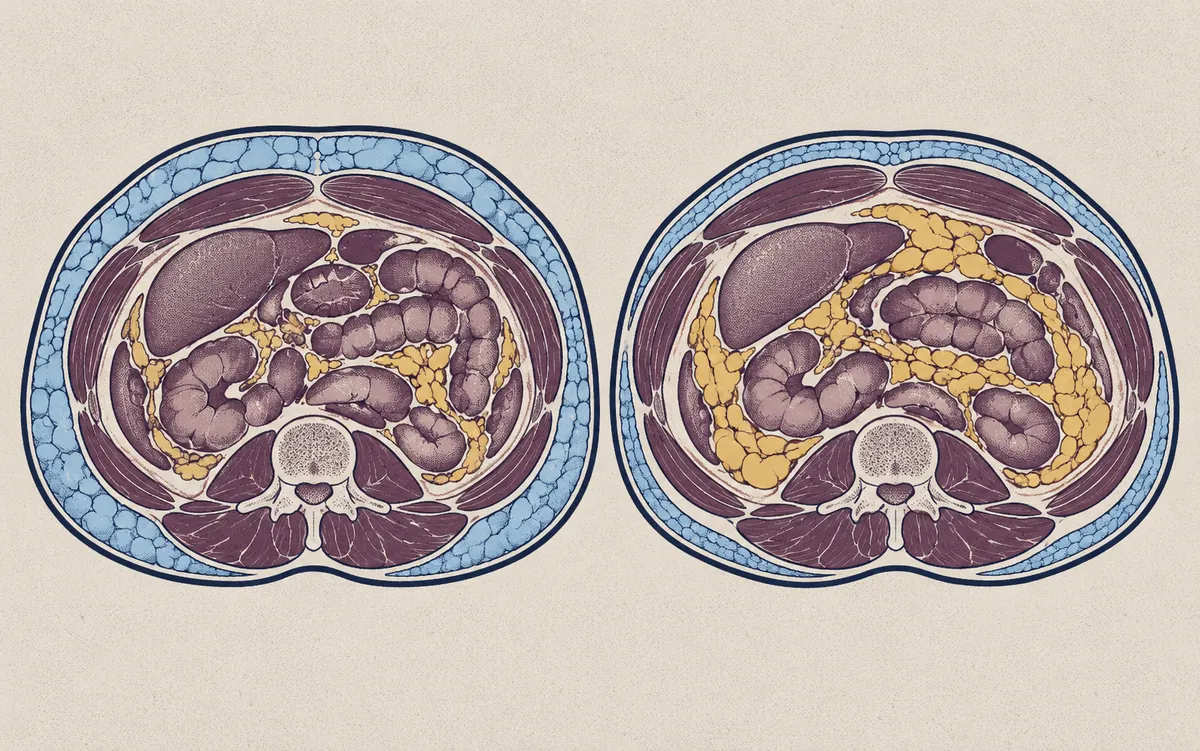
Quick answer: Visceral fat is the fat packed deep in your belly, around organs like your liver and intestines. It’s different from the soft fat under your skin that you can pinch, and it’s more closely linked to problems like high blood pressure, high blood sugar and heart disease. You can’t see it on a scale, but a tape measure around your waist gives you a quick clue, and a DEXA scan can estimate it more closely. Regular exercise helps bring it down, even without changing your diet.
The three kinds of body fat
Most of us picture body fat as one soft layer. In fact, your body keeps fat in three different places, and each one behaves differently. The deeper the fat sits, the more it tends to affect your health.
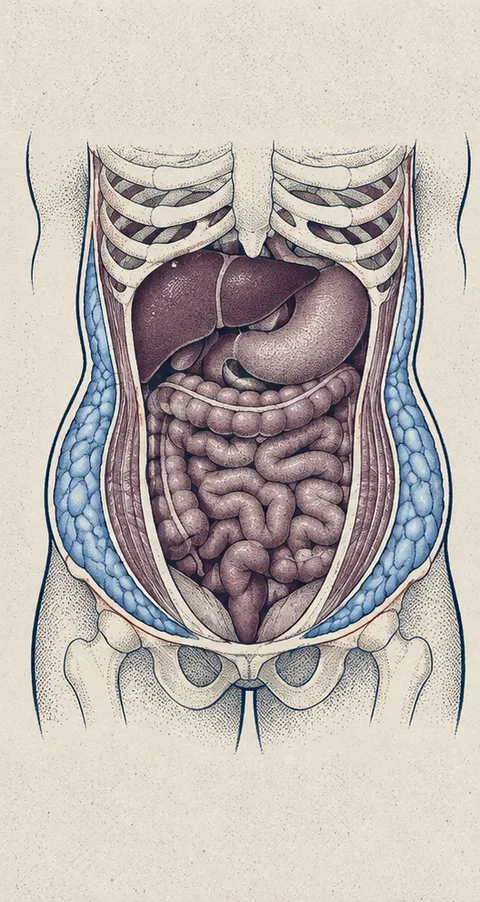
Under the skinSubcutaneous fat
- Where it sits
- Just under your skin, all over your body, including your belly, hips and thighs.
- Can you feel it?
- Yes. It’s the soft fat you can pinch.
- How much of your fat
- Most of it.
- What it’s linked with
- The least risk of the three. On the hips and thighs it may be fairly harmless.
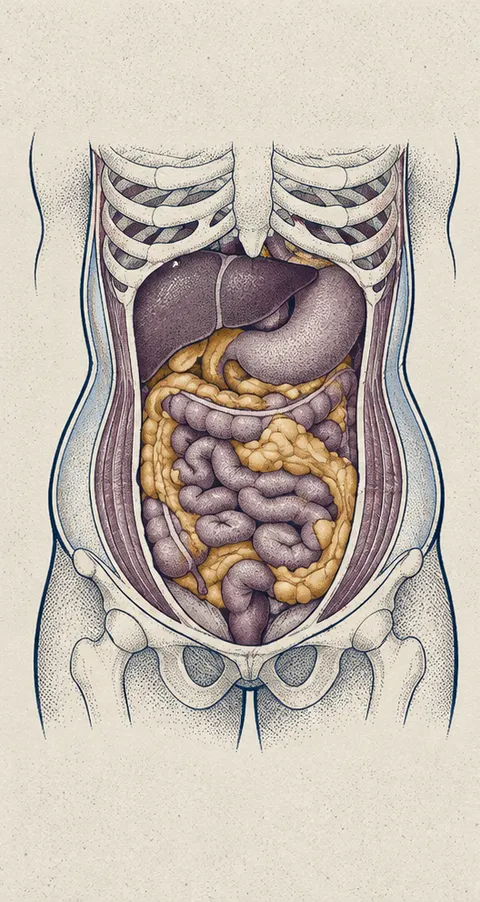
Around your organsVisceral fat
- Where it sits
- Deep in your belly, behind your stomach muscles, packed around your intestines, liver and other organs.
- Can you feel it?
- No. You can’t pinch it, but it can make the belly look firm and round.
- How much of your fat
- A much smaller share.
- What it’s linked with
- Heart disease, type 2 diabetes, high blood pressure and fatty liver.
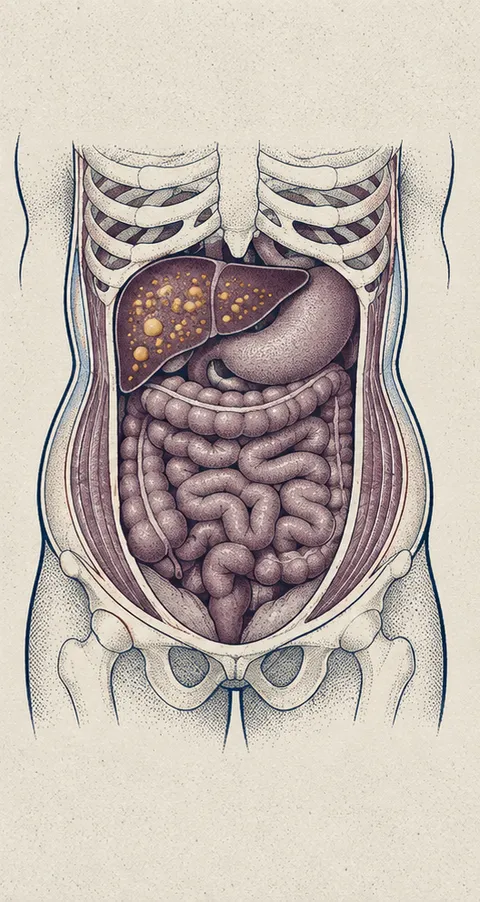
Inside your organsMostly liver fat
- Where it sits
- Inside the organs themselves, most often the liver, and sometimes the muscles, heart or pancreas.
- Can you feel it?
- No. It usually causes no symptoms at all.
- How much of your fat
- Small amounts, but small amounts matter.
- What it’s linked with
- Fatty liver, which affects about 4 in 10 U.S. adults, plus higher blood sugar and cholesterol.
So you can’t tell how much visceral fat someone has just by looking. A firm, round belly can hold more of it than a soft one. And because a scale only shows your total weight, two people who weigh the same can carry very different amounts of the fat that matters most.
Why your body stores fat in the first place
Body fat isn’t the enemy. It’s your body’s energy savings account. When you eat more than you need, your body tucks the extra away as fat, and when you need fuel later, between meals, overnight or on a long walk, it draws from those savings. A lean adult carries enough stored fat to fuel the body for weeks. For most of human history, that was a lifesaver.
The trouble starts when the deposits keep coming and the withdrawals don’t. If you sit most of the day and eat a bit more than you use, the safe storage space under your skin slowly fills up. Once it’s full, the extra has to go somewhere, and it starts spilling into the deeper spaces around your organs, and then into organs like the liver.
Think of it like a house where the storage closet is full. You start leaving boxes in the hallway, then the kitchen. Visceral fat is what happens when fat runs out of good places to go. That’s also why moving more helps so much: every time your muscles work, they draw on those savings, and visceral fat is often among the first to go.
Why visceral fat matters more
Both kinds of fat are linked to health risks, but visceral fat is linked more strongly. In the Framingham Heart Study, which scanned the bellies of about 3,000 adults, visceral fat was more closely tied to high blood pressure, high blood sugar, high triglycerides and low “good” HDL cholesterol than the fat under the skin was.
One reason may be where it drains. Think of two storage rooms in a house. The fat under your skin is like a room off the main hallway: whatever leaves it spreads out through the whole house. Visceral fat is like a room with a door that opens straight into the kitchen. Whatever leaves it goes right to one place first. In your body, that place is the liver, because visceral fat drains into a vein that leads directly there.
Why the liver matters so much
Most people think of the liver as the organ that handles alcohol. It does much more than that. It’s your body’s chemical factory: it makes most of your cholesterol, decides how much sugar to release into your blood between meals, and helps clear insulin. When it’s working well, you never notice it.
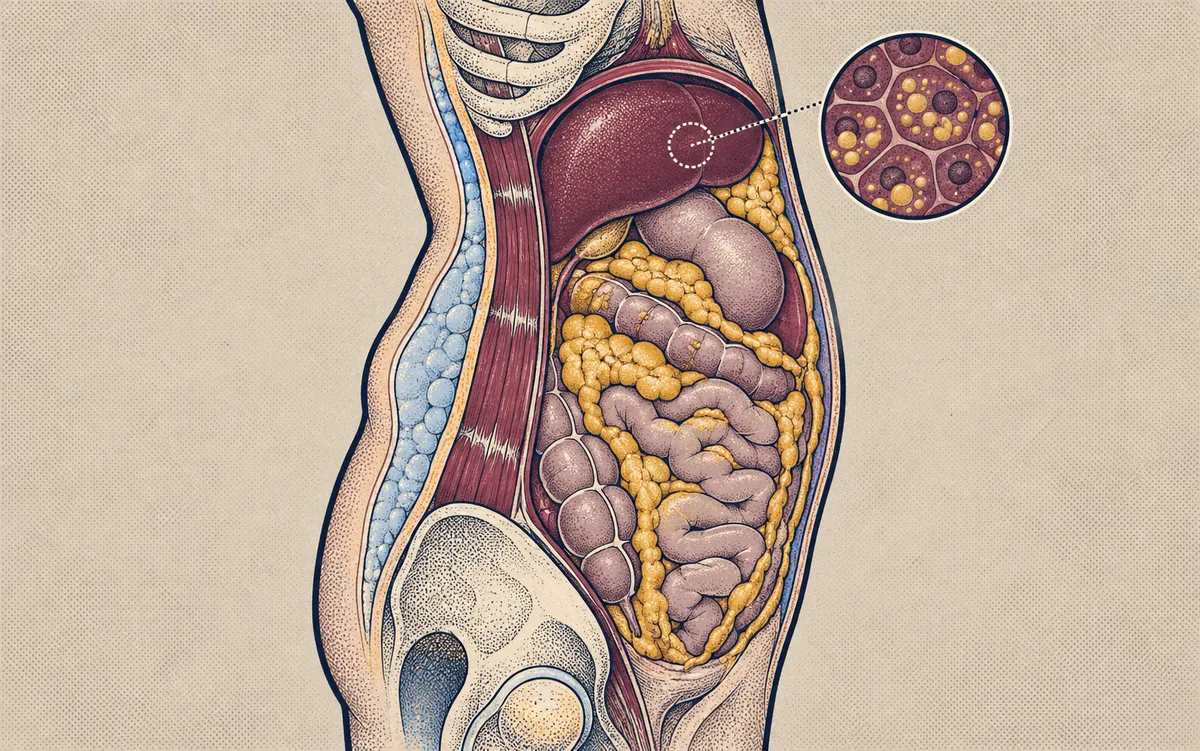
Visceral fat changes that. It sends a steady stream of fat and inflammation-causing signals straight to the liver. Over time, fat builds up inside the liver itself, a condition now called MASLD (it used to be called fatty liver disease). A fatty liver tends to make more of the particles that carry cholesterol into your arteries, release more sugar into your blood, and respond less well to insulin. So a problem that starts as belly fat can show up as high cholesterol and high blood sugar, through the liver.
It’s also far more common than most people realize. About 4 in 10 U.S. adults have some fat build-up in the liver, and most don’t know it, because it usually causes no symptoms. And here’s the part that surprises people: for those with a fatty liver, the most common cause of death isn’t liver disease. It’s heart disease.
Researchers still debate exactly how much of the risk this explains, but it’s a big reason doctors pay attention to where your fat sits, not just how much you have.
See clinics near you that offer a DEXA body composition scan.
How visceral fat affects the rest of your body
Visceral fat isn’t just stored energy sitting still. It’s active tissue that sends out signals, and when there’s too much of it, those signals affect organs all over your body.
Visceral fatsends out fat and inflammation signals that reach:
- LiverFat builds up inside it. It makes more cholesterol-carrying particles and releases more sugar.
- Blood sugarYour body responds less well to insulin, raising the risk of type 2 diabetes.
- Heart and blood vesselsMore plaque in the arteries and higher blood pressure.
- Everything elseLinked with sleep apnea, some cancers and kidney strain.
Sources: Neeland IJ et al., Lancet Diabetes and Endocrinology (2019); AHA scientific statement (2022)
longevityclinicshub.comYour liver. As above, fat builds up inside it, and it starts making more cholesterol-carrying particles and releasing more sugar.
Your blood sugar. Visceral fat makes your body respond less well to insulin, the hormone that moves sugar out of your blood. In the Dallas Heart Study, which followed 732 adults with obesity for seven years, people with more visceral fat were more likely to develop prediabetes or type 2 diabetes. Fat under the skin of the belly wasn’t linked to higher risk.
Your heart and blood vessels. The extra cholesterol particles and constant low-level inflammation both help plaque build up in your arteries. Visceral fat is also linked with higher blood pressure. Together, these raise the risk of heart attack and stroke.
Everything else. More visceral fat has also been linked with sleep apnea, some cancers, and kidney strain, often through the same paths: inflammation, insulin resistance and blood pressure.
How belly fat, including visceral fat, affects how long you live
A quick note on words first. “Belly fat” means all the fat around your middle: the soft fat under the skin and the visceral fat deeper inside. Studies of long life usually measure waist size, because it’s easy to measure in hundreds of thousands of people. A tape measure can’t separate the two kinds, but a bigger waist usually means more visceral fat, and researchers think that deeper fat drives much of the risk below.
With that in mind, here’s what waist size tells us about how long people live. A large study pooled 11 groups of people, more than 600,000 adults in all, and followed them over time. People with the largest waists died earlier than people with the smallest waists, even when they had the same BMI.
- Men with the largest waists (43 in. or more) about 3 years shorter
- Women with the largest waists (37 in. or more) about 5 years shorter
50%higher risk of dying during the study for men with the largest waists, vs waists under 35 in.
80%higher risk for women with the largest waists, vs waists of 27 in. or less
Source: Cerhan JR et al., Mayo Clinic Proceedings (2014)
longevityclinicshub.comThe risk climbed steadily with every couple of inches. For each extra 2 inches around the waist, the risk of dying during the study went up by about 7% for men and about 9% for women. So it isn’t only about being “overweight.” Where the weight sits matters, and the belly is the place to watch.
These are averages from large groups of people, not a forecast for you. But they’re a big reason longevity clinics pay attention to visceral fat, and a good reason to measure your waist even if your weight looks fine.
How to measure it
There are three main ways, from simplest to most precise.
| Question | Tape measure | DEXA scan | CT or MRI |
|---|---|---|---|
| What you get | Your waist size | An estimate of your visceral fat | A direct picture of your visceral fat |
| Can you do it at home? | Yes | No | No |
| Radiation | None | Very low | CT yes, MRI none |
| Best used for | A quick, free check you can repeat | Tracking changes on the same machine | Research and medical questions |

At home with a tape measure. Stand up, wrap the tape around your middle just above your hip bones, and read it just after you breathe out. U.S. health guidance says risk goes up above 40 inches for men and above 35 inches for women who aren’t pregnant. This can matter even if your weight is normal, because your weight doesn’t show where your fat sits.
One honest catch: a waist measurement picks up the fat under your skin as well as the fat around your organs, so it’s a clue, not an exact reading. Different guides also tell you to place the tape in different spots, and each spot gives a slightly different number. So the most useful comparison is your own waist against your own last measurement, taken at the same spot.
With a DEXA scan. A DEXA body composition scan shows your fat, muscle and bone, and many machines also report a visceral fat number. That number is estimated from the scan rather than measured directly, so it’s best compared against your own earlier scans on the same machine. Our DEXA guide explains how the scan works. At clinics that publish a price, a DEXA scan costs $65 to $249.
There’s more to weight than a number.
A whole-body DXA report separates estimated mass into fat, lean soft tissue and bone mineral content.
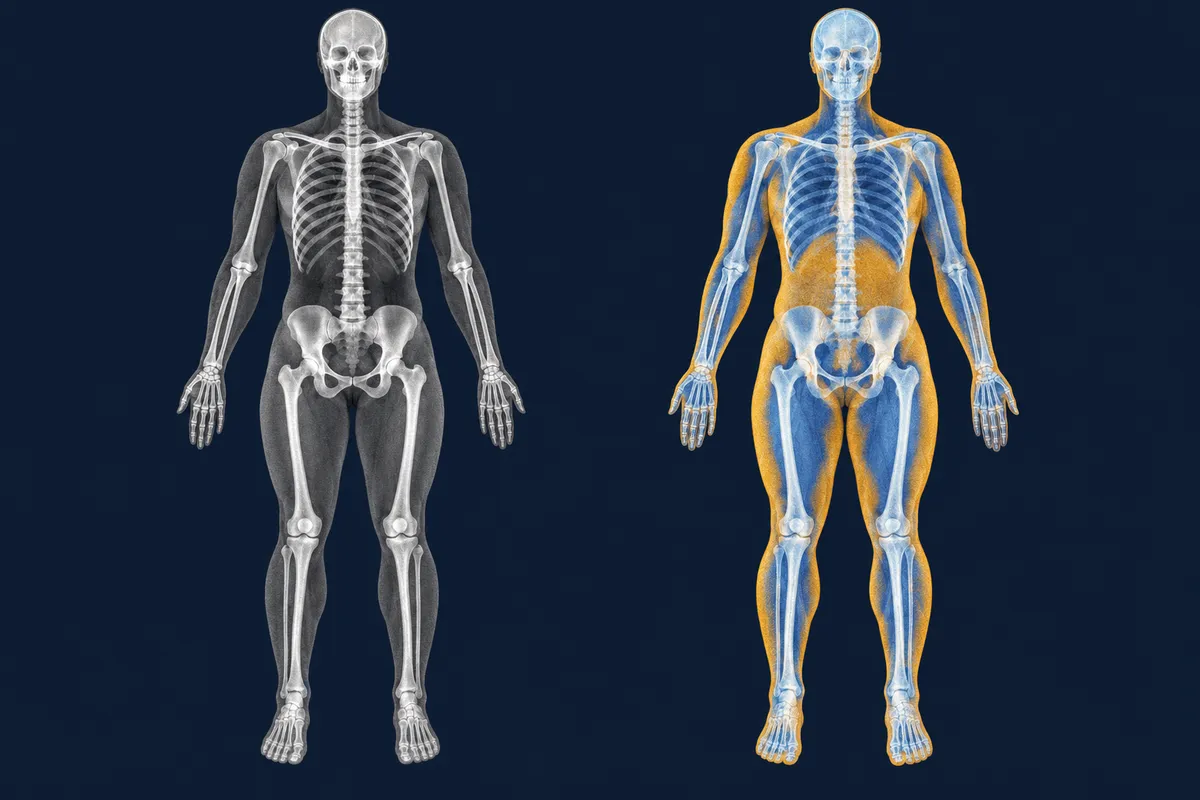
Lean soft tissue includes muscle, organs and water. It is not a muscle-only measurement.
AI-generated educational illustration · not a patient scan
Colors explain tissue categories; they are not a measured tissue map.
Estimated fat across the body.
Includes muscle, organs and water.
The mineral component of bone.
30% fat · 66% lean soft tissue · 4% bone mineral
Example values, not targets or reference ranges.
Lean soft tissue is not a direct measurement of muscle alone. A body composition scan also does not replace a dedicated hip-and-spine bone-density exam.
With CT or MRI. These scans show visceral fat directly and are the most accurate. They’re mostly used in research or when there’s another medical reason for the scan.
What your waist size can and can’t tell you
A waist measurement is a great early warning sign, especially for people whose weight looks normal. In one study of more than 15,000 U.S. adults, people with a normal weight but a lot of fat around the middle had a higher risk of dying early than people with a normal weight whose fat sat elsewhere.
At the same time, once your doctor already knows your blood pressure, cholesterol and blood sugar, adding your waist size doesn’t change your heart risk estimate much. A very large analysis of more than 220,000 people found exactly that.
Put those together and the waist’s real job becomes clear. Think of it like the warning light on your car’s dashboard. It doesn’t tell you exactly what’s wrong, but it’s cheap, quick and tells you when to get the engine checked. If your waist is above the healthy range, that’s a good reason to make sure your blood pressure, cholesterol and blood sugar have been checked recently. Your regular doctor is the place to start.
What your result can mean, and what a clinic does with it
You don’t have to make sense of these numbers alone. A good clinic reads your waist or scan alongside your other results and turns them into a plan. Here are a few common situations. They’re illustrations, not advice; your own doctor will look at your full picture.
| If your result shows... | What it might mean | What a clinic might suggest |
|---|---|---|
| A waist above 40 inches (men) or 35 inches (women) | More fat around the middle than is ideal, which is linked with higher health risks | Check blood pressure, cholesterol and blood sugar, then a plan focused on exercise and food, with your waist rechecked in a few months |
| A high visceral fat number on a DEXA scan | More fat packed around your organs | A cardio and strength plan, food changes, and a repeat scan on the same machine in about 6 to 12 months |
| A normal weight but a large waist | Fat sitting in the place linked with more risk, even though the scale looks fine | The same blood checks as above, because a normal weight can hide this |
| Signs of fat in the liver on a scan or blood test | Fat building up inside the liver | A talk with your doctor, who may suggest more liver tests and a plan to bring it down |
What helps bring visceral fat down
Exercise helps, even if you don’t change what you eat. A review of 15 studies, covering about 850 people who exercised for at least eight weeks without dieting, found their visceral fat went down. Aerobic exercise, like brisk walking, cycling or running, showed the clearest effect. Strength training helped too. Moderate and harder workouts worked; very light ones didn’t show much change.
What doesn’t work is “spot reducing.” Doing endless sit-ups won’t burn fat from your belly specifically. Your body decides where it loses fat from, and the studies above looked at whole-body exercise, not ab workouts.
Changes in diet, sleep and alcohol can also help, and a doctor or dietitian can tailor a plan to you. If you want to track your progress, measure your waist the same way each time, or repeat a DEXA scan on the same machine a few months apart. For more on muscle and fat as you age, see muscle loss with age.
Enter your ZIP code to see clinics near you that offer DEXA body composition scans.
Common questions
Is visceral fat the same as belly fat?
Not quite. “Belly fat” includes both the fat under your skin and the visceral fat around your organs. Visceral fat is only the deeper part.
Can I measure visceral fat at home?
Not directly, but your waist size is a good clue. Measure just above your hip bones after you breathe out, and compare it against your own earlier measurements taken the same way.
My weight is normal. Should I still check my waist?
Yes, it’s worth it. You can have a normal weight and still carry extra fat around your middle, and that combination has been linked to higher health risks.
Does a DEXA scan measure visceral fat?
It estimates it from the scan. CT and MRI measure it directly. A DEXA estimate is still useful for tracking change, as long as you compare scans from the same machine.
If my waist is normal, does that mean I’m healthy?
Not on its own. It’s a good sign, but it doesn’t replace regular checkups and the screening tests your doctor recommends for your age.
Prepared by the LongevityClinicsHub editorial team. How we research and source these guides.
Keep reading
Sources
- Fox CS et al., Abdominal visceral and subcutaneous adipose tissue compartments: the Framingham Heart Study. Circulation
- Emerging Risk Factors Collaboration, BMI and abdominal adiposity and cardiovascular disease: 58 prospective studies. The Lancet
- Neeland IJ et al., Visceral and ectopic fat, atherosclerosis, and cardiometabolic disease: a position statement. The Lancet Diabetes and Endocrinology
- National Heart, Lung, and Blood Institute: Assessing your risk
- MedlinePlus: Obesity screening
- Sahakyan KR et al., Normal-weight central obesity and mortality. Annals of Internal Medicine
- Wang J et al., Comparisons of waist circumferences measured at 4 sites. American Journal of Clinical Nutrition
- Bosy-Westphal A et al., Measurement site for waist circumference affects its accuracy. Journal of Nutrition
- Neeland IJ et al., Dysfunctional adiposity and the risk of prediabetes and type 2 diabetes in obese adults. JAMA (2012)
- Duell PB et al., Nonalcoholic fatty liver disease and cardiovascular risk: a scientific statement from the American Heart Association (2022)
- Díaz LA et al., prevalence of MASLD in U.S. adults, NHANES 2017 to 2018. Communications Medicine (2024)
- Vissers D et al., The effect of exercise on visceral adipose tissue: a systematic review and meta-analysis. PLOS One
- Cerhan JR et al., A pooled analysis of waist circumference and mortality in 650,000 adults. Mayo Clinic Proceedings (2014)
- Prices: our math, from the published prices of the clinics we track
This guide is independent editorial content, written to orient, not to diagnose. It is not medical advice, and it is no substitute for a conversation with a licensed physician who knows your history. Where we describe what clinics claim, the claim belongs to the clinic.
Educational reading, not medical advice. Talk to a clinician about your own health.